
I’ve been thinking about Dynamic Teaming while working on our allotment.
The aim is simple: learn how to grow food from a system that is becoming increasingly fragile.
And it turns out the allotment has been teaching me rather more than how to grow vegetables.
We started in the usual way.
Plant the crops we want. Remove the things we don’t want. Weed. Water. Control.
Basically, command and control, but with cabbages.
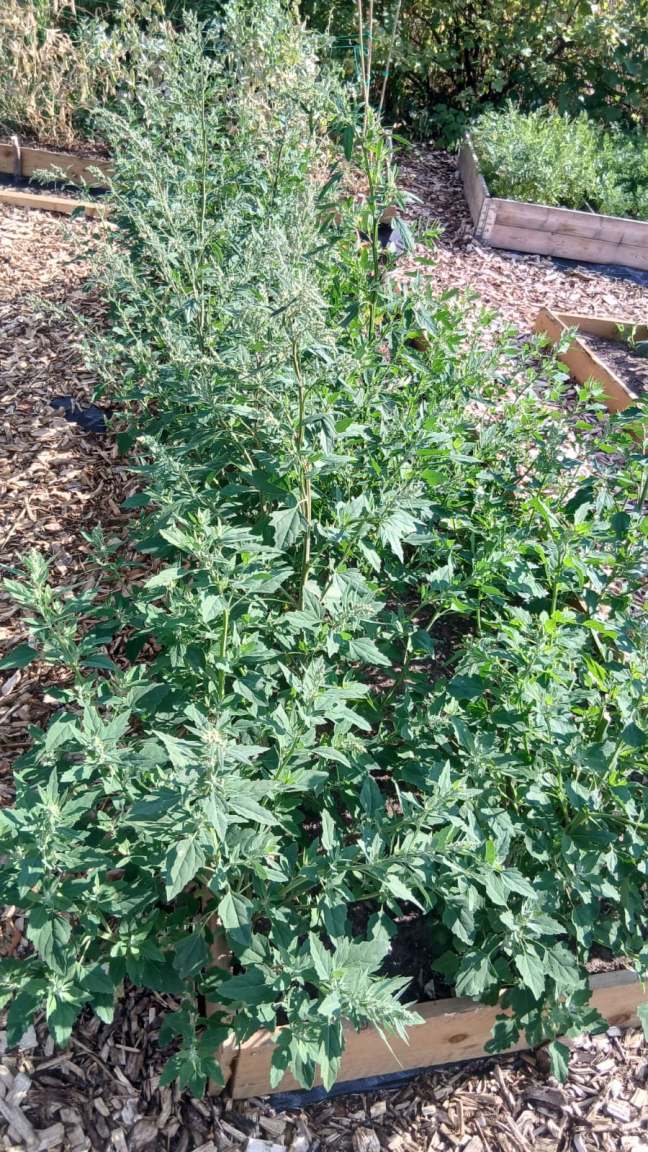
Then we noticed something. This plant had appeared in an empty vegetable box.
Fat Hen — Chenopodium album.
Our first instinct was to remove it. But we’re also keen foragers, so we knew that Fat Hen is nutritious and edible. So instead of pulling it out, we left it.
And it just… got on with growing.
No irrigation. No fertiliser. No fuss.
While I was lugging heavy barrels of water around trying to keep our precious crops alive through the heat, Fat Hen was quietly getting on with the job.
And perhaps it was doing more than that.
It provides habitat and food for insects and interacts with the wider ecosystem in ways that aren’t immediately obvious to us.
It wasn’t competing with us. It was participating in the system.
And that got me thinking about teams.
We have been trained to see nature through a particular lens: competition, dominance, control, survival of the fittest.
Even our leadership language reflects it.
OODA loops. Competitive advantage. Command and control. Winning. Dominance.
But nature isn’t simply a battlefield.
It’s also cooperation, symbiosis, adaptation, redundancy, diversity, feedback and emergence.
And this is where I think getting teams outside matters.
When we take a team into nature, we physically remove people from the environments in which they’ve been conditioned to think.
The meeting room disappears.
The hierarchy becomes less visible.
The PowerPoint disappears.
And something interesting can happen.
People start to notice. They explore. They talk.
They see things differently. They become more comfortable with uncertainty.
They begin to recognise that not everything needs to be controlled to be useful.
That’s at the heart of Dynamic Teaming.
I’m not arguing that hierarchy is always bad.
When the proverbial poo hits the fan, someone may need to direct operations.
But resilient communities and teams shouldn’t require permanent hierarchy to function.
The more complex the environment, the more valuable distributed intelligence becomes.
And that requires psychological safety, trust, dialogue, creativity, diversity of thought and the ability to let useful things emerge rather than constantly trying to manufacture them from the top down.
Our allotment has become a tiny laboratory for this.
We thought we were growing vegetables.
Actually, we’re learning about resilience.
Fat Hen doesn’t care about the geopolitical situation.
It doesn’t care about supply chains.
It doesn’t wait for a strategic plan.
It simply possesses a set of characteristics that allow it to thrive within a changing system.
Perhaps that’s a little bit of Wilderness Wisdom we could bring back into our organisations.
So here’s my question:
What might your team discover if you stopped trying to control everything and created the conditions for something useful to emerge?
Because the next challenge to organisational resilience may not be solved by another strategy document.
It might require us to become a little more wild in our thinking.
🌱 Dynamic Teams. Dynamic Communities. Wilderness Wisdom.
What could your team create to offset the challenges coming through the general geopolitical f*ckwittery of leadership right now?
Fancy a chat?
#DynamicTeaming #WildernessWisdom #TeamDevelopment #ResilientTeams #Leadership


Discover more from
Subscribe to get the latest posts sent to your email.
