
Abstract
The Observe-Orient-Decide-Act (OODA) loop, conceptualised by military strategist John Boyd, has long served as a framework for decision-making in dynamic and competitive environments. However, its mechanistic and reductionist tendencies render it ill-suited to address the complex, interconnected challenges of the 21st century. This paper critiques the limitations of OODA and presents a novel model, EDUCE (Evaluate-Decide-Understand-Commit-Evaluate), as a sense-making and decision-making tool. EDUCE fosters creativity, collaboration, and ecological coherence by incorporating a CRAP (Consequences, Real Costs, Assumptions, and Prosperity) filter to address overlooked dimensions of decision-making. By shifting from “decision-making” to “decisioning,” EDUCE offers a regenerative approach for creating sustainable and socially just futures.
Introduction
Decision-making frameworks like OODA have been praised for their agility and effectiveness in high-stakes, competitive contexts. However, they are predominantly shaped by a mechanistic worldview that prioritises efficiency over coherence and neglects the broader ecological and social consequences of actions. This paper explores the limitations of OODA and argues for the adoption of EDUCE, a framework designed to address the shortcomings of conventional models by emphasising creativity, collaboration, and ecological coherence.
Critique of the OODA Loop
The OODA loop’s sequential structure—Observe, Orient, Decide, Act—drives decision-making through divergent observation, convergent orientation, and emergent action. While this approach is effective in fast-paced, adversarial scenarios, it has significant limitations:
- Ecological Blind Spots: OODA does not explicitly account for second- and third-order effects of decisions. Its focus on immediate outcomes can lead to externalising costs onto ecosystems and marginalised populations.
- Assumption of Competition: Rooted in military strategy, OODA reinforces a competitive mindset, often at the expense of collaboration and long-term sustainability.
- Reductionist Bias: The framework aligns with left-brain dominance, as described by McGilchrist (2019), privileging linear, analytical thinking while neglecting holistic and integrative perspectives.
- Lack of Coherence: By focusing on divergence and convergence without addressing coherence, OODA risks creating solutions misaligned with the broader ecological and social systems they impact.
Introducing the EDUCE Model
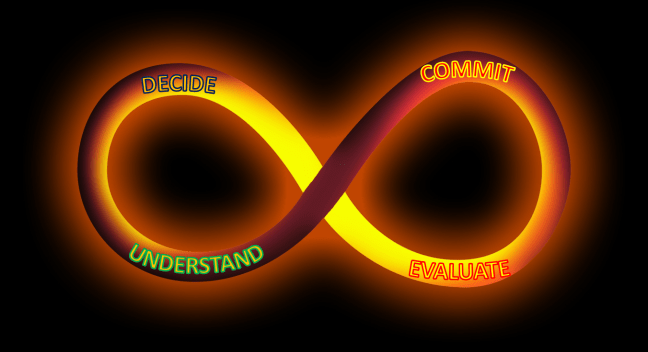
The EDUCE framework—Evaluate-Decide-Understand-Commit-Evaluate—offers an alternative approach to sense-making and decision-making. Drawing inspiration from systems thinking and ecological paradigms, EDUCE encourages decision-makers to lead out potential (Latin: educere) rather than merely reacting to stimuli.
Core Differentiators
- Collaborative and Creative Orientation: EDUCE prioritises collaboration over competition, recognising the evolutionary success of humans as a product of cooperation.
- Ecological Coherence: Through iterative evaluation and the CRAP filter, EDUCE ensures decisions are aligned with ecological and social prosperity.
- Holistic Integration: The model integrates left- and right-brain modes of thinking, fostering a balance between analytical precision and creative insight.
The CRAP Filter
To address overlooked dimensions of decision-making, the CRAP filter introduces the following checks:
- Consequences: What are the second- and third-order effects of this decision?
- Real Costs: What costs are being externalised onto people and the planet?
- Assumptions: Are we questioning foundational assumptions, such as the necessity of competition?
- Prosperity: Is this decision a net positive for the long-term wellbeing of people and the planet?
Application of EDUCE
Case Study: Transitioning to Regenerative Business Practices
A hypothetical organisation seeking to adopt regenerative business practices could use the EDUCE framework to navigate this transition.
- Evaluate: Conduct a comprehensive analysis of current practices using the CRAP filter to identify ecological and social costs.
- Decide: Make an informed decision about whether to transition based on insights from the evaluation phase.
- Understand: Develop a deep understanding of the systemic changes required, fostering collaboration among stakeholders.
- Commit: Allocate resources and align organisational culture with the new regenerative paradigm.
- Evaluate: Continuously monitor progress, refining practices based on new data and feedback.
This iterative process promotes resilience, adaptability, and coherence in organisational decision-making.
From Decision-Making to Decisioning
EDUCE reframes decision-making as “decisioning”—an ongoing, dynamic process rather than a finite act. This shift recognises the emergent nature of complex systems and the need for continual adjustment in response to changing circumstances.
Conclusion
The OODA loop, while effective in its original context, is insufficient for navigating the complexities of the modern world. Its limitations in addressing ecological coherence and fostering collaboration necessitate a new approach. The EDUCE framework, with its emphasis on creativity, collaboration, and ecological alignment, offers a path forward for creating regenerative, socially just futures. By incorporating the CRAP filter and embracing decisioning as an iterative process, EDUCE provides a robust alternative for those seeking to make the world a more prosperous and harmonious place.
References
- Boyd, J. R. (1996). Patterns of Conflict.
- McGilchrist, I. (2019). The Master and His Emissary: The Divided Brain and the Making of the Western World. Yale University Press.
- Senge, P. (1990). The Fifth Discipline: The Art & Practice of the Learning Organization. Doubleday.
- Meadows, D. H. (2008). Thinking in Systems: A Primer. Chelsea Green Publishing.
- Capra, F., & Luisi, P. L. (2014). The Systems View of Life: A Unifying Vision. Cambridge University Press.
#EDUCEModel
#DecisionMaking
#EcologicalLeadership
#SystemsThinking
#CollaborativeLeadership
#RegenerativeFuture
#SustainableLeadership
#AdaptiveThinking
#HolisticDecisions
#ResilientLeadership
#McGilchristInsights
#DecisioningNotDeciding
Discover more from
Subscribe to get the latest posts sent to your email.
